Disruption does not always arrive in the form of a headline. Sometimes it comes quietly: a relocation, a family emergency, a visa issue, a health concern, a school staffing gap that stretches from one week into six, or decisions made by the Ministry of Education.
While this is happening, students do not usually say, ‘My continuity plan is failing’; they just drift. Logins drop, confidence slips, and work gets patchy. Then comes a loss of rhythm, belonging, and direction. This is the real issue school leaders and parents must solve together. Not simply access to curriculum, but continuity of learning as a lived experience.
The First Break Is Usually Not Academic
Here is what people miss. Students rarely fall behind because they suddenly cannot learn. They fall behind because the adults around them are not aligned with their education.
While one side assumes the school has it covered, the other thinks the family will stabilize things at home. Meanwhile, the student sits in the middle, trying to decode expectations with very little clarity.
It is well established that disruption and ambiguity are costly. A continuity model must establish clear routines, visible checkpoints, familiar platforms, real teacher presence, without panic and endless patchwork.
What School Leaders Must Stabilize First
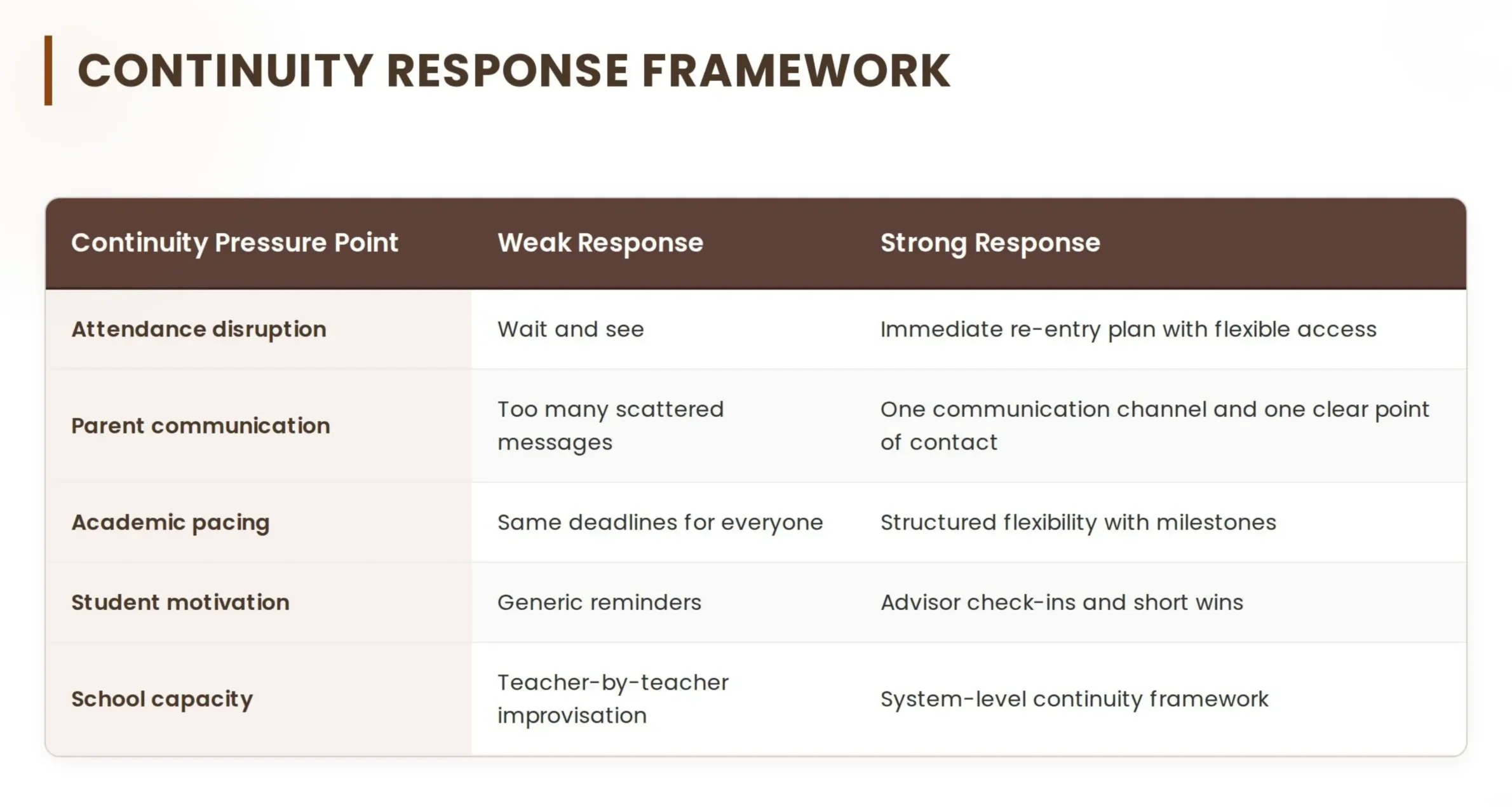
When it comes to continuity, school leaders need to think in layers, not slogans. Continuity needs to be operational before it becomes inspirational. The reason is that if systems are loose, goodwill will not save them.
A student needs a dependable route back into learning, even when life gets messy. That means the school’s academic model must bend without breaking. The strongest schools do three things early, without making a big performance out of it.
- They define the non-negotiables, meaning what every student must experience each week.
- They simplify communication, so families don’t have to hunt through multiple tools and mixed instructions.
- They build flexible learning pathways that preserve rigor without pretending every student is in the same situation.
What Parents Notice Before Schools Do
Parents usually see the emotional signs first. Irritability, avoidance, or the phrase “I’m behind anyway.” These feelings matter, and parents need to step in. If parents act like supporting actors, they will miss these early warning signals.
Parents, however, cannot carry the full burden of understanding everything on their own. What families need is not more jargon, and not a flood of polished updates. Parents need practical visibility. What is essential this week? What can wait? Who will notice if the student disappears for a few days? Those questions sound simple, but they are not.
This is exactly why a continuity partner matters. Not in a flashy way, but in a structural way. Copperstone Education connects flexible learning pathways with school support, family communication, and academic guidance that does not collapse when circumstances change.
For school leaders, this kind of partnership can reduce operational strain, for parents, it lowers confusion, and most importantly for students, it keeps momentum alive.
When continuity is well designed, support feels steady, not improvised. And this difference is huge, which students can feel immediately.
Continuity Works When Adults Move in the Same Direction
Education continuity is no longer a backup plan. Today, it is the core design of serious schooling.
The quest is no longer about understanding and resolving disruptions, but about building a pre-emptive learning structure that can absorb shocks without passing all the stress down to the student.
As a result, when schools and parents work in tandem following the same framework, students recover faster, stay more engaged, and remain connected to a future that feels reachable. Education continuity is a plan for success.
At Copperstone Education, we partner with schools and families to make this continuity seamless, reliable, and effective even during the most challenging times.

Tony Crawford
Tony Crawford is an American educator with more than 40 years of experience as a teacher, administrator, mentor for teachers in training, consultant, and educational leader. Motivated by the belief, “Who dares to teach must never cease to learn,” Mr. Tony consistently supports fellow educators in the pursuit of innovative practices and professional growth. He currently serves as Vice President of Educational Excellence at Copperstone Education.
Throughout his career, Mr. Tony has served as a teacher consultant for the National Geographic Society, chaired the National Education Association’s Resolutions Committee, and served on both the Oregon High School Diploma Requirements Task Force and the Oregon Legislature’s School Accountability Task Force. He has also been a member of the NEA’s Teacher Professional Standards and Practices Committee.
Mr. Tony has worked as an accreditation reviewer for schools throughout the Middle East region and currently serves as a trustee on the Western Oregon University Foundation Board. When he is not supporting schools and educators, Mr. Tony enjoys training for marathons.
Our Fact Checking Process
We prioritize accuracy and integrity in our content. Here's how we maintain high standards:
- Expert Review: All articles are reviewed by subject matter experts.
- Source Validation: Information is backed by credible, up-to-date sources.
- Transparency: We clearly cite references and disclose potential conflicts.
Our Review Board
Our content is carefully reviewed by experienced professionals to ensure accuracy and relevance.
- Qualified Experts: Each article is assessed by specialists with field-specific knowledge.
- Up-to-date Insights: We incorporate the latest research, trends, and standards.
- Commitment to Quality: Reviewers ensure clarity, correctness, and completeness.
Look for the expert-reviewed label to read content you can trust.